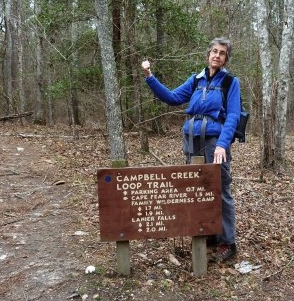
Carlette Blackmon
Biography
Carlette Blackmon taught at UNCG for 15 years from 1996 until she retired in 2011.
Carlette graduated from Eastern Alamance High School in Mebane, NC in 1963, and attended UNCG for two years before transferring to UNC Chapel Hill. She graduated with the AB in Mathematics Education in 1967 from Chapel Hill and taught high school mathematics in Burlington for five years. Around 1982 her family moved to Georgia, and Carlette took the position of Chair of the Mathematics and Computer Science Department at St. Andrew School (K-12) in Savannah, GA. When her family moved back to Burlington around 1989, she did not immediately seek employment, but she tutored students from Eastern Guilford and Burlington High Schools. After a few years, the tutoring load became almost a full-time job. At that point Carlette decided to look into college level teaching. She inquired at Elon College about job opportunities and was told that as soon as she had a master’s degree, she had a job waiting for her at Elon. She decided in 1993 to seek a master’s degree in math and go from there to teaching at the college level. She came to UNCG master’s program and graduated with a master’s degree in 1996.
The story of how she came to teach at UNCG has an interesting twist. The interview at Elon College gave her the added incentive to seek a master’s degree, which she completed in 1996. A few days after graduation, the UNCG math department contacted her with the offer of a part time job. Carlette accepted the offer and remained employed at UNCG in part time and full-time roles until she retired. Unfortunately, Elon was robbed of a top-quality instructor.
Her colleagues agree that Carlette was loved by most of her students. Her office was usually full of students with more waiting in the hallway. She would worry aloud about students whose grades were below where she thought they should be. Carlette worked hard on her courses, often typing lecture notes and distributing them to her class. She enthusiastically adopted innovations in teaching as the came along such as calculators and later computer software modules that nowadays complement textbooks.

Charles Church
Biography
Dr. Charles A. Church Jr., associate professor, Department of Mathematics, 27 years of service, retired August 31, 1994. He specializes in combinatorics (a branch of number theory).

Paul Duvall
Biography
Paul Duvall graduated from Davidson College in 1963 with a BA in Mathematics and from The University of Georgia with MA (1965) and PhD (1967) degrees in Mathematics. His priciple mathematical interest was Geometric Topology.
Paul went through the ROTC program at Davidson and received a reserve commission as a US Army Second Lieutenant, together with an obligation to serve on active duty. When he finished his PhD work, he stayed on at Georgia as an Assistant Professor for two quarters while waiting for his Army Assigment. In the spring of 1968, he went on active duty. After completing the Infantry Officer’s Basic Course, he spent the rest of his military obligation at Fort George G. Meade in the Mathematics Research Office of the National Security Agency. During his time at NSA he became interested in the applications of mathematics to cryptography, and when his military tour ended, he continued his affiliation with NSA by making annual visits as a consultant.
When Paul’s military duty ended in the spring of 1970, he joined the Mathematics Faculty at Virginia Tech as an Assistant Professor in fall 1970. He then moved to Oklahoma State University as an Associate Professor in the fall of 1971. He was promoted to Professor in 1977, and served as Acting Head of the Mathematics Department in 1984-85.
During his years at OSU, Paul continued his research in geometric topology. Most of his work in those years was concerned with the exciting interplay among classical differential and combinatorial topology, infinite dimensional topology, and shape theory. In particular, he and colleague Don Coram discovered and developed the theory of approximate fibrations, a generalization of the standard theory of Hurewitz fibrations.
Paul came to UNCG in 1986, where he was hired as Department Head. He served as Head until 2000, a total of 14 years.
When Paul arrived at UNCG, the Mathmatics Department was trying to bring Computer Science into its curriculum. The Department was already teaching some computer science courses, all of which were in high demand. These courses were staffed by Math faculty who had retrained in various topics in computing. As computing became more popular with students, the department wanted to offer a degree in Computer Science, but in 1986 the department did not have a single faculty member with a PhD (or MS) in computer science. Thanks to the efforts of Department Head Richard Sher and several of the faculty, the Department had been granted “permission to plan” for a (BS) major in Computer Science by the UNC Central Administration. The Department made development of the Computer Science group a high priority, recruited the appropriate faculty, and soon received permission to offer the BS in Computer Science. In the next few years, the Department’s BS degree in Computer Science received national accreditation from the Association for Computing Machinery. A few years later, the department went through the UNC degree process again, and began offering a Masters degree in computer science.
In the years that Paul served as department head, his mathematical interests turned toward topological aspects of chaos theory, fractals and discrete dynamics. He enjoyed fruitful collaborations with Larry Husch and James Keesling on these topics. In particular, Duvall and Keesling solved an open problem by applying their studies of the boundaries of fractal sets to show that the boundary of the notorious “Levi’s Dragon” is a fractal set.
Paul’s interests in NSA’s mathematical problems increased steadily throughout his career, and by the time he stepped down as department head, almost all of his research time was devoted to the mathematics of cryptography. He spent the 2000-2001 academic year at Fort Meade as a Visiting Staff Member for the Institute for Defense Analyses’ Center for Computing Science at nearby Bowie, MD. When he returned to UNCG in 2001, he continued his consulting work in summers and other break times. In addition to his visits to Fort Meade, he participated in a number of classified summer workshops in La Jolla, CA; Princeton, NJ; El Segundo, CA and Bristol, England.
In 2000, General Michael Hayden, the Director of the NSA, sent a letter to UNCG’s Chancellor commending Paul’s work. Here are a few lines from General Hayden’s letter:
“Dr. Duvall has been an expert mathematical consultant to the National Security Agency for over two decades, and he is famous for his ability to rapidly identify and solve the mathematical problems at the core of complex technical challenges. The recent victory in which Dr. Duvall played a decisive role represents one of the most spectacular advances in classified mathematical techniques in the past four decades. This achievement will have a dramatic impact on our signals intelligence mission for many years.”
Throughout his time at UNCG, Paul was active in teaching and university service. He won the College of Arts and Sciences Senior Faculty Teaching Excellence Award in 2012. At the state level, he served several terms (1992-99, 2004-2010) as a delegate the UNC state system’s Faculty Assembly, including two years as Secretary of the Assembly and two years as Chair of the Assembly’s Budget Committee. He also served as a member of the Advisory Board for the North Carolina Early Mathematics Testing Program from 1996 until he retired.
After Paul stepped down as Head in 2000, he continued his service to the department by becoming the departments Director of Graduate Studies. In that role he was actively involved in developing the curriculum for the Department’s application for a PhD in Computationial Mathematics. The application was successful, thanks largely to the leadership of Alex Chigogidze, who was Department Head at that time. The Department started its new PhD program in 2008. Paul continued in the role of Director of Graduate Studies until 2011.
Paul retired from UNCG at the end of the 2015 academic year.
Karl Gentry
Biography
When Karl Ray Gentry entered Wake Forest University as an Freshman, his interests were in Accounting and French. He studied French for six semesters, but eventually became a math major. He was graduated from Wake Forest University in 1960 with a BA in Mathematics. The department head of mathematics at Wake Forest recommended Karl to Professor M. K. Fort who was seeking graduate students for his Ph. D. program at the University of Georgia, and Fort offered Karl a NEDA Fellowship to attend graduate school at UGA. Karl accepted the offer and was finishing his dissertation when Professor Fort suddenly died. Karl finished his degree under the direction of B. J. Ball, and was graduated from the University of Georgia in 1965. His Ph. D. dissertation is entitled “Inverse Limit Spaces; Periodicity and Transformation Groups.”
Karl joined the UNCG mathematics faculty in 1965. He was one of the first mathematicians recruited to UNCG to support the Math Department’s new master’s degree programs in mathematics. He wrote seven research papers with the late Hughes Hoyle, III who was also among the early contributors to the master’s program at UNCG until he moved to The Citadel in 1986. Karl remained on the UNCG faculty until he retired in 2000. Karl stays active on his family farm, which he manages with his three brothers.
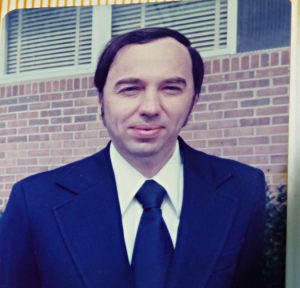
1975

Patricia Griffin
Biography
Pat Griffin was born and reared in Reidsville, NC. In 1956 she was selected to attend the First Girl Scout Roundup in Milford, Michigan. She was graduated from Reidsville High School in 1959, and that fall she matriculated in The Woman’s College of the University of North Carolina. In her junior year she was vice-president of her class. In her Senior year she was elected to Phi Beta Kappa and was voted one of the ten outstanding members of her class.

In 1963, she was graduated from Woman’s College with a BA in Math. After graduation, she worked as a mathematician at the US Naval Research Laboratory in Washington D.C. for almost three years, then taught 7th and 8th grade math at Thoreau Intermediate School in Fairfax County, VA for a year. She spent the next year teaching 10th grade math at Page Senior High School in Greensboro. During 1967-1969, Pat entered Graduate School at UNCG and became a teaching assistant. In 1969, she and Maryanne Austin Hedgepeth became the first people to receive a Master of Arts degree in Mathematics from UNCG. Pat’s master’s thesis was entitled “On the order listing of permutations.” The following fall Pat joined the growing faculty in mathematics at UNCG.
Pat continued to teach at UNCG until her retirement in 1997. She taught a variety of math courses including College Algebra, Trigonometry, Calculus I, II, and III, and a computer-programming course (CSC 236) and Calculus with computing during the 1980’s. The department head at that time, Dr. Eugene Posey, thought it was a worth having someone with knowledge in math working quarter-time in Academic Advising, and he selected Pat for that assignment. After Posey stepped down as head, the new head decided this was no longer necessary, and Pat returned full time to the Math Department. During her years at UNCG, Pat served as faculty advisor for the Square Circle Club (a local Math Club established by Helen Barton when she became department head in 1926) and she was the faculty advisor for the North Carolina Epsilon Chapter of Pi Mu Epsilon, the National Honorary Mathematical Society.
Since retiring to her farm in Stokes County, Pat has stayed busy enjoying gardening, mowing, crocheting, repairing small engines, solving puzzles, visiting with friends, reading and volunteering with Stokes County Habitat for Humanity. Recently Pat wrote to us: “It seems that I have always wanted to teach at UNCG and live in the country.” Mission Accomplished!
Testimonials
Pat was a wonderful person! She taught me Calculus I in 1994. Every day at the beginning of class she’d have some interesting story about raising chickens or installing a basketball goal or her time in the Navy working on aircraft carriers. It was like learning calculus from your overactive grandma. Yes, it was a surreal experience that I feel lucky to have had a chance to undergo. — Richard Cheek

Sat Gupta
Biography
Before retiring on June 30, 2025, after a 50-year academic journey spread across several institutions, Professor Sat Gupta served as a Professor of Statistics (2004-2025) and Department Head (2019-2023) in the Department of Mathematics and Statistics at the University of North Carolina at Greensboro. He is a Fellow of the American Statistical Association, and an Elected member of the International Statistical Institute.
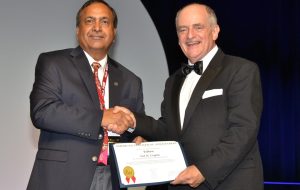
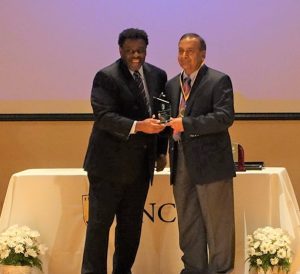
During his career, he bagged several honors and awards which include the Senior University-wide Research Excellence Award at University of North Carolina Greensboro; College of Arts and Sciences Senior Teaching Excellence Award, University of North Carolina at Greensboro; University-wide Undergraduate Research Mentor Award at UNC Greensboro; Outstanding Faculty Award and the Outstanding Teacher/Scholar Award from the University of Southern Maine; the Distinguished Service Award for the Cause of Statistics given by the North Carolina Chapter of the American Statistical Association; and the Sankhyiki Bhushan Award from The Indian Society of Agricultural Statistics. He is also the winner of the AORN Journal Writer’s Contest for 2016. He has been the founding Editor-in-Chief since 2007 of the prestigious research journal ‘Journal of Statistical Theory and Practice’, published by Springer. Professor Gupta also serves as General Chair of the important biennial international conference on advances in interdisciplinary statistics and combinatorics held at UNC Greensboro (2007-2024).
Professor Sat Gupta had his college education from Delhi University where he earned a PhD degree in mathematics in 1977. After teaching assignments at Shri Ram College of Commerce and Sri Venkateswara College, Professor Gupta came to USA in 1982 where he earned a PhD degree in statistics in 1987 from Colorado State University. Thereafter, he joined University of Southern Maine where he taught from 1986 – 2004 and then moved to The University of North Carolina Greensboro where he served as Professor of Statistics, Associate Head, and Head. He has published over 175 journal articles and has several edited-book volumes to his credit including one with Professor C R Rao. He has also given over 170 talks, many at international destinations. Professor Gupta’s journal articles cover a wide range of theoretical and applied topics. The current focus of his research is on respondent privacy in survey sampling and data confidentiality.
He has provided research guidance to students at all levels from undergraduate to PhD. As of Summer 2025, his research advisees include 14 PhD students, 21 master’s students, and 20 undergraduate students. He has received funding from agencies like the National Science Foundation, National Institute of Health, Mathematical Association of America and the Robert Wood Johnson Foundation. His external grants as PI/Co-PI/Co-Investigator add up to 11 million dollars, with about 1 million of that as PI.
A somewhat unique aspect of his career is that he has successfully applied his knowledge of the subject of statistics in providing ‘Statistical Consultancy’ to both on-campus and off-campus communities. On-campus, he has provided consultancy to researchers from many disciplines such as biology, marine biology, education, nursing, nutrition, anthropology, economics, public health, genetic counseling, psychology and medicine. These consultations have resulted in numerous journal articles. His off-campus consultancy includes his work with biotech companies and his testimony as expert witness in many court cases.
Testimonials
“He (Sat) has received many well-deserved recognitions from UNCG, ASA, and world-wide organizations. I am so proud and honored to be considered as his friend. He continues to impact on many future statisticians even in his retirement. I am truly grateful to him and for him to be a beacon of light in North Carolina for our profession.” — Sastry G. Pantula, Dean College of Natural Sciences, California State University San Bernardino, ASA President (2010)
For more testimonials and tributes from students and professional colleagues upon Dr. Gupta’s retirement, please refer to the 2025 AISC Symposium: In Celebration of Professor Sat Gupta’s Retirement, starting on page 22.

David Herr
Biography
David G. Herr graduated from R. J. Reynolds High School in Winston-Salem, N.C. in 1955. He became a statistician through an unusual route. He was awarded two degrees from the Georgia Institute of Technology, an undergraduate degree in Electrical Engineering, after which he changed directions and obtained a master’s degree in Mathematics. He then went to the University of North Carolina at Chapel Hill where he obtained a Ph.D. degree in Statistics in 1966. His dissertation entitled “Asymptotically optimal tests for an exponential family of distributions,” was written under the direction of Wassily Hoeffding, one of the founders of nonparametric statistics.
David G. Herr’s first academic appointment was at Duke University. He came from there to the mathematics department at UNCG in 1973 where he remained until he retired in 2002. At UNCG, Dr. Herr taught statistics courses, published articles on statistical research and classroom notes, and he also worked in the department’s Statistical Consulting Center where he helped researchers at UNCG in other fields with the statistical analysis of their experiments. As a result of his consultations, he sometimes was a joint author on their publications. For example, we mention his paper with Jacquelyn W. Gaebelein in the UNCG psychology department, “Nonorthogonal two-way analysis of variance,” Psychological Bulletin, Vol 85(1), Jan 1978, 207-216. David carried into retirement his love of photography, especially wildlife and landscapes, and his love of sailing.
Theodore Hildebrandt
Biography
Professor Theodore (Ted) Hildebrandt (8 December 1922 – 29 April 2017) received his Bachelor’s degree in Physics in 1942 from the University of Michigan. He then enlisted in the U.S. Navy where he remained until the end of World War II. Following the war, he returned to Ann Arbor to pursue a Master’s degree in mathematics, since he felt that the field of physics would be dominated by nuclear studies, which did not interest him.
During his first semester back at the University of Michigan, his father, Professor Theophil H. Hildebrandt, who was the Chair of the University of Michigan Department of Mathematics from 1934-1957, gave him a paper written by Arthur Burks, Herman Goldstine and John von Neumann entitled “Preliminary discussion of the logical design of an electronic computing instrument.” Theophil wanted Ted’s assessment of the proposal. Ted read the paper and became very excited by it, so much so that when his father mentioned that Herman Goldstine was looking for engineers to work on the computer project in Princeton, he jumped at the chance. He worked on the Princeton Project with von Neumann and Goldstine at the Institute for Advanced Study for about 18 months. While he was at Princeton, he took graduate courses in mathematics and had the credits transferred to the University of Michigan where he completed the MA in math in 1947.
After working on the Princeton Project, Ted decided to pursue a Ph.D. in mathematics and applied to MIT, where he was offered a graduate assistantship in math. In addition to working on the degree at MIT, he worked on Project Whirlwind, a flight simulation project. Unfortunately, he failed his initial attempt at the Ph.D. preliminary exams and was advised to write a Master’s thesis. He wrote his thesis on the problem of determining the deflection of a spherical shell, like the end of a pressure vessel, under a concentrated load. Ted was awarded the Master of Science in Mathematics by MIT in 1951. Because of his difficulties at MIT, Ted decided to return to Michigan to finish a Ph.D. in mathematics. He heard later from his father that his advisor at MIT was disappointed that he did not return there.
Ted’s work on his doctorate was interrupted when he was called up from the Naval Reserve to serve in the Korean War. He was assigned to the US Naval Computing Machine Laboratory in St. Paul, Minnesota, where he spent 18 months before being released from active duty. In the fall of 1954, Ted was encouraged to apply for a fellowship at the Oak Ridge Institute of Nuclear Studies to work on his dissertation. He and his wife, Ruth, moved to Oak Ridge in January 1955, and he received his Ph.D. in 1956 from the University of Michigan. His dissertation concerned two problems and was entitled: “I: Iterative Methods for the Approximate Solution of Linear Algebraic Equations. II. Self-adjointness in One-group Multi-region Diffusion Problems.” It was published as Oak Ridge National Laboratory Report ORNL-2146. The publication can be found on the Internet in PDF form. After Ted received his Ph.D., he went to Ohio State University where he held various positions. He was the Assistant Director of Computing Center, and advanced from Assistant to Associate, and then Full Professor of Mathematics. He eventually became Professor and Associate Chairman, Division of Computer and Information Science.
During 1968-1969 Ted was Director of the Computing Center and Professor of Computer Science at Kansas State University, and during 1969-1974 he was Head, Computing Facility, and Consultant to Director at the National Center for Atmospheric Research in Boulder, CO. During 1974-1976 Ted worked at the US Department of Commerce, Office of Telecommunications, Institute for Telecommunication Sciences, as Expert Consultant on Computer Software.
Ted came to UNCG in 1976, as Professor of Mathematics and Director of the Academic Computer Center that had opened its doors on October 1, 1973. The purpose of the Center was to advance academic computing (as opposed to administrative computing). Some computing on campus was being done using the big mainframe IBM 370 computer at the Triangle Universities Computing Center (TUCC). Major “big data” computing needed all the computing power available, especially in the Business School, and in some science computing. In 1980 sufficient funding became available for the purchase of a computer exclusively for use in academic computing at UNCG. Ted determined the DEC VAX-11/780 mini computer was the best use of those funds, and purchased that computer and related peripherals. Our sources say that the bulk of the funds used to purchase the VAX (about $300,000, a small fortune at the time) came from the foresight of the Dean of the Business School, David Shelton, who allocated funds left over from the construction of the new building for the School of Business. The Academic Computer Center was moved into the new building, and a special room was constructed in that building for housing the VAX computer. Interface with the VAX mini computer was by terminals; the VAX could accommodate up to 32 users across campus at one time. The year 1980 was one year before the arrival of the IBM personal computer and the beginning of the personal computer revolution, which eventually moved terminal-based computing to desktop computing.
In 1986, Ted resigned as Director of the Computer Center and returned full time to the Department (then named the Department of Mathematics, Computer Science and Statistics). He taught courses in the fledgling area of computer science, with an emphasis on numerical analysis, strengthening the department’s efforts in that area. Ted retired from UNCG in 1993.
After Ted retired, he was active in SeniorNet, a non-profit organization that helps older people access computer technologies. He taught courses, revised course material and developed new course material for SeniorNet in Greensboro and was a SeniorNet coach in Colorado. He sang in the Greensboro Choral Society, and was active at St. Francis Episcopal Church, and sang in the choir. He moved back to Colorado in 2005 to be with his daughter, Sarah and his son.
With the help of Ted’s daughter, Sarah, we were able to identify the following publications by Ted Hildebrandt:
- OSLP ‒ the Ohio State Linear Programming Code ‒ The OSUSYS Subroutine Library (1965)
- A Computer Science Program at the Ohio State University (abstract) American Mathematical Monthly 73 8 (1966) p 925
- Report of the Computer Study Committee, Board of Regents, State of Kansas, 1969 (contributor and editor)
- Plan for the Acquisition of Additional Computing Capability, NCAR, 15 November 1972 (contributor and editor)
- Plan for Meeting Augmented Computing Requirements for NCAR/UCAR, 6 August 1973 (contributor and editor)
Ted married Ruth Eleanore Stein in 1953. She had a Master’s degree in piano performance from the University of Michigan School of Music. They had four children: Sarah, Paul, Thomas and Lise. Ruth died in 1961. Ted married Mary K. Babcock in 1962. Mary K. had degrees in physical education and dance from Michigan State University and Teachers College of Columbia University, with additional graduate work at New York University. They had a son, Peter. Mary K. died in 1998.
Linda Kilgariff
Biography
From the College of Arts and Sciences News Letter Spring 2009
Linda Kilgariff has served on the UNCG faculty for 40 years and has compiled a remarkable record of contributions to the university. She received her BA (graduating Cum Laude and a member of Phi Beta Kappa) from UNCG in 1968 and her MA in mathematics in 1971. She joined the UNCG faculty in 1971. Among the many courses in mathematics and statistics that she taught, are College Algebra, Trigonometry, Calculus I, II, III, Probability, and Statistical Inference. It is estimated that during those 40 years Kilgariff taught more than 12,000 students. It was her custom to learn all of her students’ names, and this obviously contributed to her great popularity as a teacher. In addition to her teaching, Kilgariff served efficiently as administrative assistant to three department heads from 1986 to 2004. She earned both A and G certification in secondary education and put that to good use for many years as a UNCG Teaching Fellows mentor and as a student teacher supervisor in the area of mathematics. In addition, she spent 10 years working with the UNCG Fast Forward program in mathematics and served eight years as the departmental coordinator for the program. She served on four university committees including the University General Education Curriculum Committee and the Undergraduate Academic Policies and Regulations Committee. For the last three years of her career, Kilgariff was an iSchool mathematics coordinator and instructor in the Division of Continual Learning.
Contributed by Dr. Jerry Vaughan
The following is from the College of Arts and Sciences FRESHMEN SEMINARS PROGRAM SPRING SEMESTER 2005
Freshman Seminar 195-01 T, R 2:00-3:15pm, location: TBA. “Excursions in Mathematics.” Instructor: Linda Kilgariff. Department of Mathematical Sciences.
“To most outsiders, modern mathematics is unknown territory. Its borders are protected by dense thickets of technical terms; its landscapes are a mass of indecipherable equations and incomprehensible concepts. Few realize that the world of modern mathematics is rich with vivid images and provocative ideas.” Ivars Peterson, The Mathematical Tourist
Mathematics does not have to be dull and unrelated to our real world experiences. This course consists of brief excursions through selected unconventional topics from ancient through contemporary liberal arts mathematics. Along the way in this interdisciplinary mathematical adventure, the class will encounter fallacies and fuzzy sets; perfect, deficient, and abundant numbers; the double-dabble method; cryptology; wallpaper groups; the Greedy algorithm, …
Linda Kilgariff is an Instructor of Mathematics in the Department of Mathematical Sciences, where she has taught calculus and various other mathematics courses for over 30 years. She mentors mathematics Teaching Fellows and high school Fast Forward teachers and loves beach music, murder mysteries, and infinite shopping.

Andrew Long
Biography
Andrew (Drew) Fleming Long, Jr. was born in Morgantown, West Virginia and was graduated from Morgantown High School. He attended West Virginia University and was graduated in 1960 with a Bachelor of Science in Electrical Engineering. As part of this training in Electrical Engineering, he took an internship during two summers with Westinghouse Corporation. He did well during his internships, but decided that the corporate life was not his main interest. He started thinking about going in a different direction. Drew had a friend who was a chemical engineering major and was considering switching into mathematics. Eventually Drew and his friend decided to apply for an NSF fellowship for a master’s degree in mathematics. Both were awarded the fellowship, and by taking courses in summer school, Drew finished in one year. He was graduated from West Virginia University with a Masters of Arts degree in mathematics in 1961.
A member of the West Virginia math faculty, Lewis Bragg, suggested that Drew continue his education. Bragg had taught at Duke University for a number of years, and suggested Duke as a possible place for Drew to continue his studies. Drew was accepted into the Duke University Mathematics Ph.D. program in 1961. He wrote his dissertation “Factorable Polynomials in several indeterminates over a finite field” under the direction of the famous algebraist Leonard Carlitz and was graduated with the Ph.D. in math in 1965. His first academic position was at St. Andrews College, in Laurinburg, NC, and he was there for two years, but he discovered that he missed working with colleagues in his areas of research, and he would prefer to live in a larger city. A new position at UNCG offered him the opportunity to achieve both goals. He was offered the position and came to UNCG in 1967. During the 1980’s Drew attended the Institute for Retraining in Computer Science at Kent State University and following that he taught several mathematically related computer science courses at UNCG during the time that computer science was beginning its rapid advancement. A few years later, Drew did consulting work for Soabar Graphics division of Avery International and solved a production scheduling problem for them using a bin packing algorithm. Drew hoped to publish his solution, but Avery considered the computer program that accompanied it to be proprietary since the method would be of use by competitors. For this reason, he was not able to publish his results. After successful career of 34 years at UNCG, Drew retired in 2001 and took up in earnest his love of travel abroad.

Bill Love
Biography
William (Bill) P. Love was born in Tallahassee Florida, where Florida State University (FSU) is located. Florida State University School is a K-12 charter school sponsored by Florida State University. Bill attended Kindergarten there and thus began his long association with FSU. Bill continued through the twelfth grade at FSU School. After graduation from the high school, he enrolled in FSU and completed a B.S. in Physics in 1961. His goal was to work in the space program, and following graduation he obtained a position with NASA at Langley Research Center in Virginia. He found, however, the work less interesting that he had anticipated, and decided that he would much rather teach physics. He returned to FSU and received a M.S. in Science Education in 1962. He then taught for three years at Gibbs College in Saint Petersburg Florida (now called St. Petersburg/Gibbs College following a merger in 1965). After teaching Calculus at Gibbs, he decided that he liked mathematics better than Physics, and he returned again to FSU and received Ph.D. in Mathematics Education. After receiving his Ph.D., Bill accepted a position as instructor in mathematics at New College, Sarasota, Florida, but that appointment lasted only one year. He went to the AMS winter meeting in 1969 to look for another position and met Gene Posey, who was the head of the UNCG Mathematics Department and was there scouting for new faculty for the recently established UNC-Greensboro. It appeared that what Posey really wanted was a statistics instructor, so Bill did not try to meet with Posey. It turned out, however, that Posey also need someone in Math Education; so eventually Bill and Posey got together and Bill came to UNCG in 1970 as Assistant Professor in the Mathematics Department. He remained in the department until his retirement in 2001. Going from Kindergarten to Ph.D., all at FSU, may be some kind of record.
At UNCG Bill was in charge of the mathematics preparation of secondary and middle school math teachers. This job included not only advising, and teaching, but also observations of student teachers in their field experience. He taught such courses as “Math for Elementary School Teachers,” “Geometry and Algebra for High School Teachers,” “History of Mathematics,” “Calculus for Middle School Teachers” and “Abstract Algebra for Middle School Teachers.” He incorporated graphing calculators, TI-82 and TI-83, into some of his courses, and wrote a student workbook on the use of graphing calculators with instructions and activities and taught several workshops of these materials. He also developed and wrote the book for a course he developed called “Calculus and Computing,” a two semester course in the early days of computing when only IBM punch cards were used to input computer data and commands. Of course, like math faculty everywhere, Bill taught Precalculus and Calculus I, II, and III. Bill also served as the mathematical representative on a number of doctoral committees for students seeking a Doctorate of Education in the UNCG School of Education.
Bill was instrumental in bringing to UNCG a section of the North Carolina State High School Math Contest. The Contest is organized by the North Carolina Council of Teachers of Mathematics. He saw that holding a section of the contest on campus was a way to expose some top math high school students to UNCG. With the help of other faculty, Bill organized this contest at UNCG for about 5 years with around 120 students participating each year. UNCG still hosts a section of the Contest.
In retirement, Bill has developed a keen interest in carnivorous plants. He grows several different kinds and is an active member of the International Carnivorous Plant Society. He also keeps a few chickens and honeybees and tends an extensive vegetable garden. In addition to all this, Bill continues his interest in mathematics. For instance, he has continued to extend his quick method for finding the area of any arbitrary closed polyhedral by entering the coordinates of the vertices of the polyhedral into a matrix form and preforming what he calls the “criss-cross” operation.
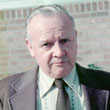
Eldon Posey
Biography
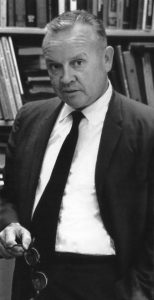 1968
1968 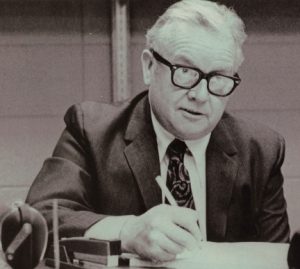 1974
1974
Professor Eldon Eugene Posey, head of the Mathematics Department at UNCG from spring 1965 – fall 1980, died on May 7, 2008 at the age of 87.
Dr. Posey, known to everyone as Gene, came to UNCG in the fall of 1964, the year the Woman’s College of the University of North Carolina became the University of North Carolina at Greensboro (UNCG). His intent was to help develop a stronger undergraduate and eventually a graduate program. He has always believed that a good mathematics library was essential for any solid mathematics program.
Gene’s first position after receiving his Ph.D. from the University of Tennessee was at West Virginia University (1954 – 1959). In 1959 he took a position at Virginia Polytechnic Institute and State University, usually referred to as Virginia Tech (1959 – 1964). Gene came to UNCG from Virginia Tech in 1964 and became head of the department in the spring of 1965.
Professor Anne L. Lewis, who was the head of the Mathematics Department at the Woman’s College, recruited Gene in 1964. The total Mathematics Department in 1963 consisted of Anne Lewis, the only Ph.D. in the department, and five instructors holding master’s degrees. When Gene arrived at UNCG in the fall of 1964, he became aware that Professor Lewis was now planning to marry and would be moving to Chapel Hill. He became head in the spring semester of 1965 and was the only Ph.D. in the department. When Gene stepped down as head in 1980, the department had sixteen Ph.D.’s and nine instructors with master’s degrees.
Gene set about transforming the small mathematics department of the Woman’s College into a university-level department. He assembled a group of research-oriented mathematicians and started two new master’s programs. These were the Master of Arts in Mathematics and the M.Ed. in Mathematics Education. Gene believed that teachers of mathematics needed a strong background in mathematics. The M.Ed. program he developed was nearly as strong in mathematics as the M.A. because the M.Ed. required only three education courses.
Gene worked hard to establish a collection of research journals and books in the small Woman’s College Library in order to make the library suitable for doing research in mathematics. This went well at first. In particular he ordered all the journals of the American Mathematical Society back to 1940, and on microfilm back to their beginnings. Another notable acquisition was the complete collection of “Fundamenta Mathematicae” all the way back to the first volume in 1920. Posey had strongly held ideas as to the basic journals that were essential to any research-level mathematical collection. At one point, however, the dean declined to authorize a subscription to a journal that Posey felt was essential. Posey did not hesitate. He wrote a check for the subscription price of the journal and sent it to the dean attached to his letter of resignation. He promptly got the check and letter back, along with the subscription to the journal.
Posey received a B.S. degree from East Tennessee State University, and an M.A. from the University of Tennessee. He received the Ph.D. degree in mathematics from the University of Tennessee in 1954. Posey’s Ph.D. advisor was the distinguished mathematician Orville Goodwin Harrold, Jr. who received his Ph.D. from Stanford University in 1936 under the direction of James Victor Uspensky.
Posey’s dissertation was entitled “Almost Polyhedral Cells in Euclidean 3-Space.” Results from it appeared in the article “A characterization of tame curves in three-space” written with his advisor O. G. Harrold, Jr and H. C. Griffith, who was also a student of Harrold’s a year ahead of Posey. The “tame curves” paper was announced in the Proceedings of the National Academy of Sciences and published in the Transactions of the American Mathematical Society 79 (1955), 12–34.
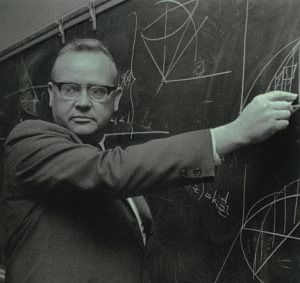
In 1964, Gene published a paper in the Duke Mathematics Journal entitled “Proteus forms of wild and tame arcs.” In this paper he introduced the concept of a “completely wild arc.” He proved that an arc is completely wild if and only if every parameterization h:[0,1] → R3 of the arc in 3-dimensional space has local maxima on an everywhere dense subset of [0,1]. Following such a parameterization by one of the projection maps results in a continuous real valued function of a real variable, which has local maxima on an everywhere dense set. At first Gene conjectured that no such real functions exist, and hence, completely wild arcs did not exist either. However, in a sequence of three papers, Posey and co-authors showed that not only did such continuous real functions exist, but also even stranger ones could be constructed.
About thirty years later, beginning Fall 2008, the department was granted permission to institute a Ph.D. in Computational Mathematics. Posey’s dream of having a Ph.D. in mathematics at UNCG was finally realized.The two master’s degree programs that Posey started at UNCG proved to be popular, and with the encouragement of the UNCG administration, Posey worked to develop plans for a Ph.D. degree in mathematics. These plans were quickly approved on campus and were under consideration by the UNC General Administration. At that point, however, the plans ran up against a consent decree between the federal government and the University of North Carolina to resolve civil rights issues. Essentially the plans for the Ph.D. program (as well as programs at other universities) were discarded because the consent decree froze some proposed programs in the state system. Those difficulties had nothing to do with the merits of Posey’s plan.
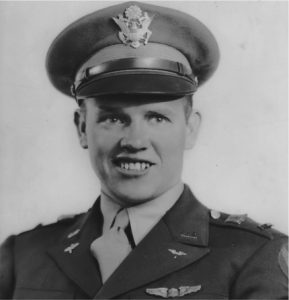
No discussion of Gene Posey would be complete without some mention of his activities during the Second World War. In fact, the war interrupted Posey’s academic career. He was in his second year of college at East Tennessee State College (now University) when he decided that America would not stand idly by while Nazi Germany conquered Great Britain. He knew war was inevitable, and he decided that if he had to go to war he wanted to go as a fighter pilot in the Air Force. In July 1941 he left college and signed up as a Cadet in the Air Force. This was five months before the attack on Pearl Harbor, which propelled America into the war.
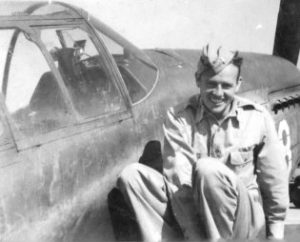
Gene spent nearly a year in cadet training and qualified as a fighter pilot in 1942. After he graduated from pilot training Gene was assigned as a test pilot in Philadelphia, and on the way there he stopped in Knoxville, Tennessee to visit his brother. While he was there he met his future wife, Christine Johnson, who was attending the University of Tennessee. They were married on Christmas day in 1943 and eventually had two children, Margaret and Daniel.
Eventually Gene attained the rank of Captain in the Air Force. He flew 50 combat missions during the Africacampaign (also some in Sicily and Italy) and was promoted to squadron leader. His plane was shot down twice in Africa. One of those times his plane was shot down near Carthage after he had destroyed two German Messerschmitt Bf 109’s, the backbone of the Luftwaffe fighter force in World War II. When his plane was hit, it was too low to safely bail out, but he managed to land in the desert. He could hear fighting nearby and was unsure of the direction to the allied lines. Luckily, he was found by a group from the Free French army, but they had difficulty convincing him they were friends-not foes-before he would accept a ride back to his base.
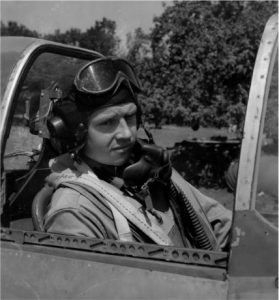
After the Africa campaign, Posey returned to Florida as a fighter pilot instructor. This stateside job did not last very long and he was soon reassigned to the European campaign. Posey flew 68 combat missions over England, France, and Germany. In one incident his plane was running low on fuel. He was strongly motivated to land somewhere other than countries occupied by Germany. Gene nursed his fuel and managed to land in Sweden. The Swedish government remained neutral during he war by making various concessions to Germany, one of which was to confine for the duration of the war any allied personnel that came into Sweden. The Swedes, however, were not allies of Germany: they helped Posey escape to England. Gene soon returned to the war in Europe, but his plane stayed in Sweden.
Towards the end of the war, during the Battle of the Bulge, he was on a reconnaissance mission and was shot down again on December 8, 1944. This time, unfortunately, his plane crashed badly and he shattered the bones in one shin and ankle into dozens of pieces. He was picked up by the Free French army and spent six months in a hospital in England. After that he was transferred to a hospital in Memphis, Tennessee where he went for further recovery for over a year. He was able to spend some of that time as an outpatient with a walking cast. His injured leg never fully recovered and for the remainder of his life his leg and ankle would be swollen at the end of the day.
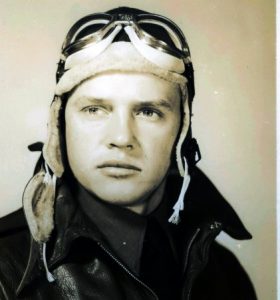
During his time in the war he was awarded an impressive array of medals and citations* including the Distinguished Flying Cross with oak leaf cluster (the Distinguished Flying Cross is a medal awarded to “any officer or enlisted member of the United States armed forces who distinguishes himself or herself in support of operations by heroism or extraordinary achievement while participating in an aerial flight”). Posey was clearly a war hero
Due to his injury Gene was not able to continue as a pilot. He told the Air Force that rather than take a desk job, he preferred to go back to college to become a teacher of mathematics. That is what he did. He returned to East Tennessee State College and completed his bachelor’s degree. He then went to the University of Tennessee in Knoxville for graduate work as previously mentioned.
Posey stepped down as department head in August 1980 to return to teaching. He retired from UNCG in 1988. Before leaving, he and his wife Christine made a generous contribution to the department’s student scholarship fund. The “Eldon E. And Christine J. Posey Mathematics Scholarship” is awarded on the basis of academic achievement to undergraduate students majoring in Mathematics. It is one of the department’s major scholarship funds, and has helped many students through the years.
Gene Posey was survived by his wife Christine, who died April 24, 2018 at the age of 96, and is currently survived by his two children, four grandchildren and one great grandchild.
* Summary of Posey’s war record.
Cadet: July 1941 – April 1942
Separated: July 1946
Qualification: Pilot
Rank: Captain
Decorations:
Distinguished Flying Cross (1 oak leaf cluster)
Purple Heart
Air Medal (12 oak leaf clusters)
Bronze Star (6 oak leaf clusters)
American Defense Medal
American Campaign Medal
European – African – Middle Eastern Campaign Medal (7 bronze stars)
Air Offensive, Europe; Algeria-French Morocco; Tunisia; Sicily; Normandy; Northern France; Rhineland WW II Victory Medal
Distinguished Unit Citation (1 bronze star)
{Oak leaf clusters denote subsequent awards of the Medal.}
Chronological Order of Service and Missions:
1942-1943: Flew 50 combat missions in Africa – Sicily – Italy
1942 (Nov 28): Shot down near Carthage after destroying two German Me 109’s. Escaped to American lines at Medjez-el-Bab.
1943 (July): Squadron Commander – Sicily
1944: Flew 68 combat missions in England – France – Germany
1944 (May 13) Interned in Sweden after running low on fuel over Germany.
1944 (June) Group Operations Officer – France
1944 (Dec 18): Shot down and wounded in an air operation over Belgium (Battle of the Bulge). Recovered by French troops.
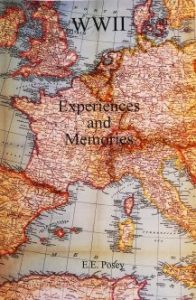
During his retirement, Gene wrote about his experiences in World War II. By the time of his death, he had completed a manuscript but died before seeing it through to publication. His family took the manuscript, added a number of relevant photos, some taken by Posey, and some from war achieves, and published the whole as a book “World War II, Experiences and Memories,” by E.E. Posey. It is available for free download as a PDF file from this address: http://www.lulu.com/product/download/wwii—paperback/5550057. It is also available as a paperback book printed on demand (with a color cover, some color maps and photos, on 80 weight paper) from http://www.lulu.com/content/paperback-book/wwii—paperback/7660432.

Carol Seaman
Biography
Carol Seaman graduated from Newberry College in Newberry S.C with honors in 1969 and then earned a MA degree in mathematics from the University of Illinois at Chicago in 1971. After a detour through the fields of child-rearing (a son and a daughter), multi-line insurance sales, and real estate, Carol returned to academia in 1989 teaching mathematics at Edison Community College in Ft. Myers Florida for six years. In 1996 after her youngest child finished high school, Carol returned to doctoral studies at Central Michigan University in Mt. Pleasant Michigan. While completing her dissertation, Carol spent the year 1999-2000 as a Visiting Professor at Albion College in Albion Michigan. After receiving her Ph. D in mathematics in 2000, she accepted an assistant professor position at the University of Wisconsin at Oshkosh, Wisconsin, where she specialized in the mathematical preparation of elementary and middle school teachers, conducting research in mathematics education and preparing curriculum materials in mathematics for these future teachers.
Carol came to UNCG in 2008 as a tenured Associate Professor of mathematics and assumed the position of program coordinator for secondary licensure in mathematics. In this role, she developed new and revised existing mathematics courses for secondary teachers at the undergraduate and the graduate level. She taught courses in calculus, Euclidean geometry, and non-Euclidean geometry as well as other courses that were specialized for licensure students and for masters students in Math Ed. While at the University, Carol also served as the organizing faculty coordinator of the RISE (Research and Instruction in STEM Education) Network and worked with colleagues in the School of Education on several NC Quest grants, providing professional development to teachers in K-12 education. She remained at UNCG until her retirement in 2018.
Carol intends to spend her retirement years enjoying family, friends, travel, and the NC mountains with her husband and dog Annie. She is also toying with the idea of acquiring a masters degree in astrophysics!

Richard Sher
Biography
Dick Sher came to UNCG in 1974. He was head of the department from 1981-1986, and he retired in 1996. Dick received a B.S. degree from The Michigan College of Mining and Technology (now Michigan Technological University) in 1960. After one year of graduate work at the University of Utah, he served for two years in the United States Army. Returning to the University of Utah, he received the M.S. in mathematics in 1964 and the Ph.D. in mathematics in 1966. His Ph.D. advisor was the noted topologist C. E. Burgess. The title of his dissertation: “Toroidal decompositions of E3.” After graduation from the University of Utah, Dick joined the faculty at the University of Georgia (1966-1974). In addition to his time at Georgia and UNCG, he was a member of the Institute for Advanced Study during the academic year 1969-70 and the fall semester of 1986.
Dick Sher and Jerry Vaughan were Editors-in-Chief of the international research journal “Topology and its Applications,” from 1979-2000. “Topology and its Applications” is devoted to research in many areas of topology, and is published by Elsevier Science B.V. in Amsterdam. After Sher retired from the university he became a member of the Advisory Board of the journal from 2000-2007.
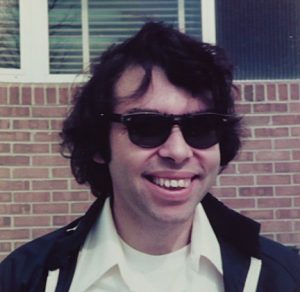 1975 1975 | 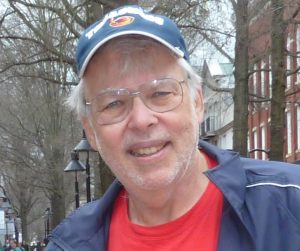 2014 2014 |

Brett Tangedal
Biography
Dr. Tangedal earned his Ph.D. from the University of California at San Diego in 1994 under the direction of Harold Stark. After holding various positions at the University of Vermont, Clemson University, and the College of Charleston, he joined the faculty at UNCG in 2007. His research interests lie in algebraic number theory with a particular emphasis on explicit class field theory. This involves the constructive generation of relative abelian extensions of a given number field using the special values of certain transcendental complex and p-adic valued functions. Almost all of his research to date is concerned with a system of conjectures, due to Stark and others, that make class field theory explicit in a precise manner using the special values mentioned above.

Jerry Vaughan
Biography
Dr. Vaughan earned a Ph.D. in 1965 from Duke University, and he joined the UNCG faculty in 1973. His research studied general topology, set theory and logic, functional analysis, and set-theoretic topology. Dr. Vaughan retired with emeritus status at the end of the spring semester in 2019 after 46 years of service.
BOOKS
The Handbook of Set-Theoretic Topology, editors K. Kunen and J.E. Vaughan, North-Holland Pub. Co., Amsterdam 1984, (1273 pages).
The Encyclopedia of General Topology, edited with J. Nagata and K. Hart, Elsevier BV 2005.
Theresa Vaughan
Biography
Theresa Elizabeth Phillips Vaughan, 67, died June 13, 2009 at Moses Cone Hospital after a very brief illness. A memorial service was held at Forbis & Dick Funeral Home 5926 W. Friendly Avenue, Thursday June 18 2009 at 7 PM with visitation immediately following the service.
Theresa was born in Kearney Nebraska, and grew up in California. She received a B.A. from Antioch College, an M.A. from American University, and a Ph. D. from Duke University all in mathematics. Professor Theresa Vaughan was a member of the Mathematics Faculty at UNCG for 21 years before retiring in 2008. She was very involved with her students, and served as chair of the Mathematics Scholarship committee. She was vice president of the Board of Directors of the International Fibonacci Association, and a member of several professional organizations. Most of her research was in algebra, finite fields, combinatorics and discrete mathematics. She was preceded in death by her mother, Jean Bostrom Phillips, a sister, Julia Redant, and a brother Randall. She is survived by her husband, Professor Jerry Vaughan, her father, Randall Phillips, and two sisters, Mary Kantor and Jeanette Irving.
In 1988, Theresa conceived the idea of a one-day regional conference on number theory and combinatorics, and she hosted the first of what grew into an annual two-day conference called SERMON which is an acronym the “SouthEastern Regional Meeting On Numbers.” SERMON has met every year from 1988 until the present (2009) at the following schools: UNC Greensboro, University of Georgia, University of South Carolina, The Citadel, College of Charleston, Wake Forest University, and Clemson University. More information may be available at http://www.math.clemson.edu/~kevja/SERMON/
 2008
2008

Walker Weigel
Biography
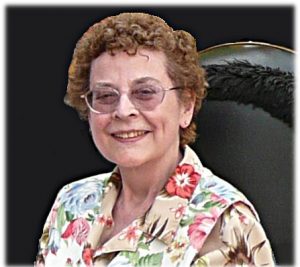
Senior Lecturer, Walker Weigel earned a M.A. in mathematics in 1967 from UNC-Chapel Hill, and followed her husband who was in the Navy, taking jobs as a computer programmer using primarily a language called Cobal. Around 1970 she and her husband moved to Greensboro so he could take a position with a local law firm. In 1972 her first child was born and she was a stay-at-home mom taking care of the baby. A second child was born in 1977, and Walker continued to stay at home until 1985 when she joined UNCG. Walker has seem numerous changes over the 33 years she has been on the UNCG faculty, especially in the off-campus courses which were known as correspondence courses then, and now are the more rigorous WEB courses. In addition to teaching she has helped analyze Drop-Withdrawal-Fail rates in the lower level courses. Walker was award the order of the Long Leaf Pine for employees of UNCG with 30+ years for “significant community service and demonstrated excellence in service.” Walker enjoys reading, cooking and hiking, all activities she will take into retirement.